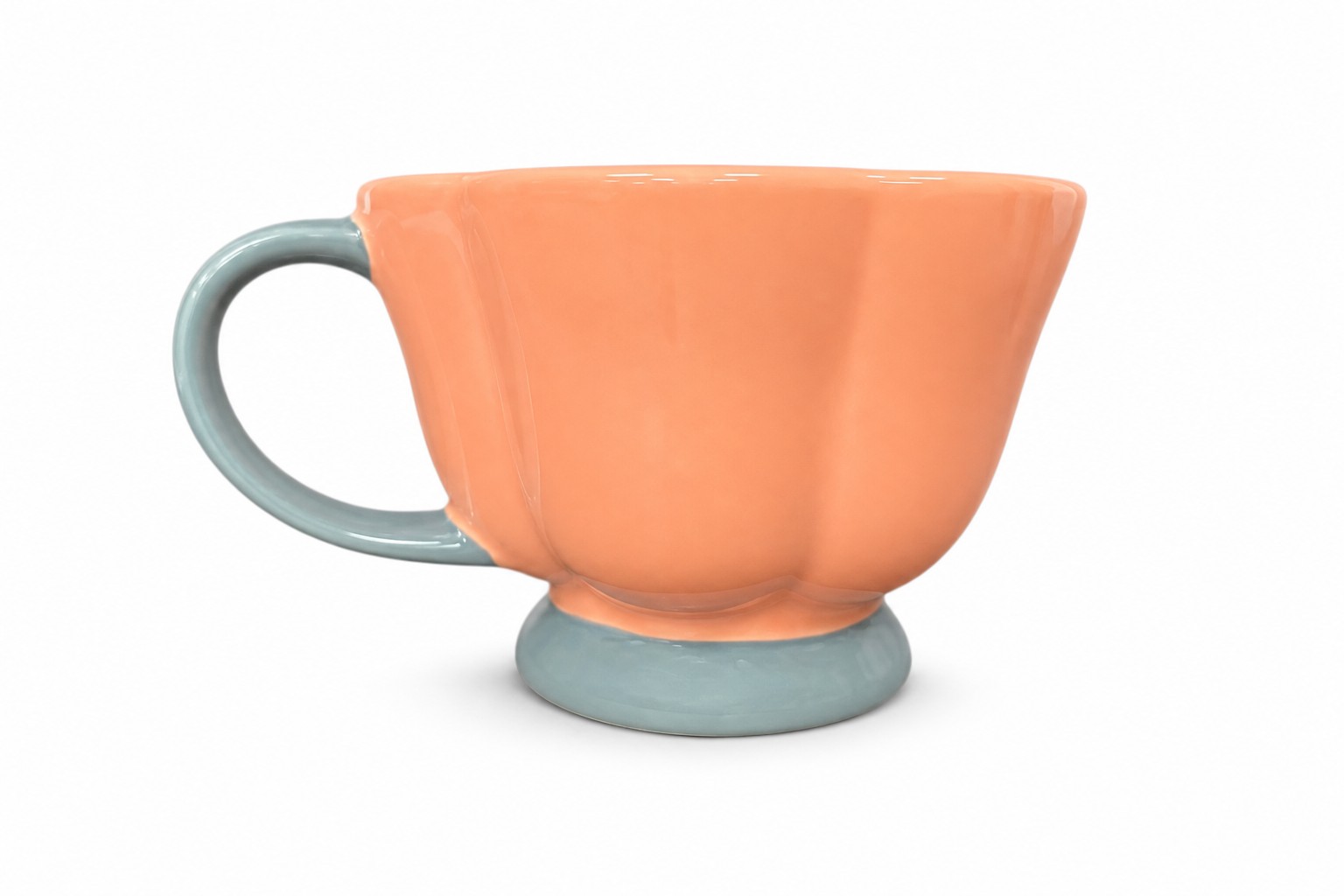
Most ceramic sourcing timelines are built around a single assumption: that a new shape cannot be sampled quickly. A traditional tooling cycle — sketch, hand-throw or hand-carve, plaster master, working mould, drying, bisque, glaze trial, second firing — commonly stretches across five to eight weeks, and any revision restarts a large part of the chain.
That assumption is a workflow problem, not a physics problem. At Fugu Ceramics in Dehua we run a parallel-track prototyping cell in which the digital model, the shrinkage compensation, the mould set and the glaze trials move simultaneously rather than in sequence. The result is a vitrified, glazed, dishwasher-tested sample in the client’s hands in 7–10 working days, with the master mould already banked for production.
This article walks through the four engineering stages that make that timeline possible.
1. Digital 3D CAD & Shrinkage Rate Engineering (12–15%)
The process starts with a parametric 3D model rather than a physical pattern. We accept STEP, IGES, Rhino, SolidWorks or STL files, and where a client supplies only a 2D drawing or a reference photo with key dimensions, our modelling team rebuilds the geometry parametrically so that wall thickness, rim radius, handle section and footring can be adjusted by parameter rather than by re-sculpting.
The critical engineering step is shrinkage compensation. A Dehua porcelain body loses 12–15% of its linear dimension between the wet slip and the fired, vitrified state, and that loss is not uniform: it is the sum of drying shrinkage (roughly 3–5%), firing shrinkage (8–10%) and a small, geometry-dependent contribution from vitrification. Thin walls and long, unsupported spans shrink differently from thick sections and enclosed volumes, so a single global scale factor is not accurate enough for a production tool.
We therefore scale the digital master per axis and per region, using measured shrinkage data from the specific body being specified — not a generic figure. The scaled model becomes the mould geometry, while the original model is retained as the target geometry. Every prototype is then scanned on a structured-light 3D scanner after firing and compared to the target in software, producing a colour deviation map. First-shot dimensional accuracy on a mug typically lands within ±0.5 mm on rim diameter and ±0.3 mm on height, which is well inside the tolerance that most retail buyers apply.
Design for manufacture is reviewed at the same moment: minimum 2.5–3 mm wall at the rim, a handle section that can be cast without a trapped air pocket, a footring that will not distort on the kiln shelf, and a parting line placed where it can be finished invisibly. Catching these in CAD costs an hour; catching them in a master mould costs a week.
2. Working Plaster Molds & Precision Slip Casting
Once the scaled master is approved digitally, it is printed at high resolution in a dimensionally stable resin, hand-finished to a 0.2 mm surface tolerance, and used to cast the plaster block mould. Dehua’s plaster shop runs its own gypsum mixing and setting regime — water-to-plaster ratio, vacuum de-airing and set time are all controlled — because mould porosity governs how fast the slip layer builds and how cleanly the piece releases.
For a typical mug we produce a two- or three-part working mould plus a separate handle mould. The first working mould is poured, cured and dried within 24–36 hours using accelerated drying rather than open-air curing, which is where a large part of the seven-day saving comes from.
Slip casting itself is the precision step. The body slip is deflocculated, viscosity- and specific-gravity-controlled (typically 1.75–1.80 g/cm³ for porcelain), and cast to a measured wall thickness rather than to a fixed dwell time — because the same dwell produces different thicknesses on a cold mould versus a warm one. The cast piece is released at leather-hard stage, the handle is joined with fresh slip and hand-blended, the footring is turned, and the piece is dried under controlled humidity to prevent the differential shrinkage that causes warping and rim cracks.
Because the working mould is derived from the same compensated CAD geometry as the eventual production tool, the prototype is not a “close approximation” — it is dimensionally the production part. What the client approves is what the factory will run.
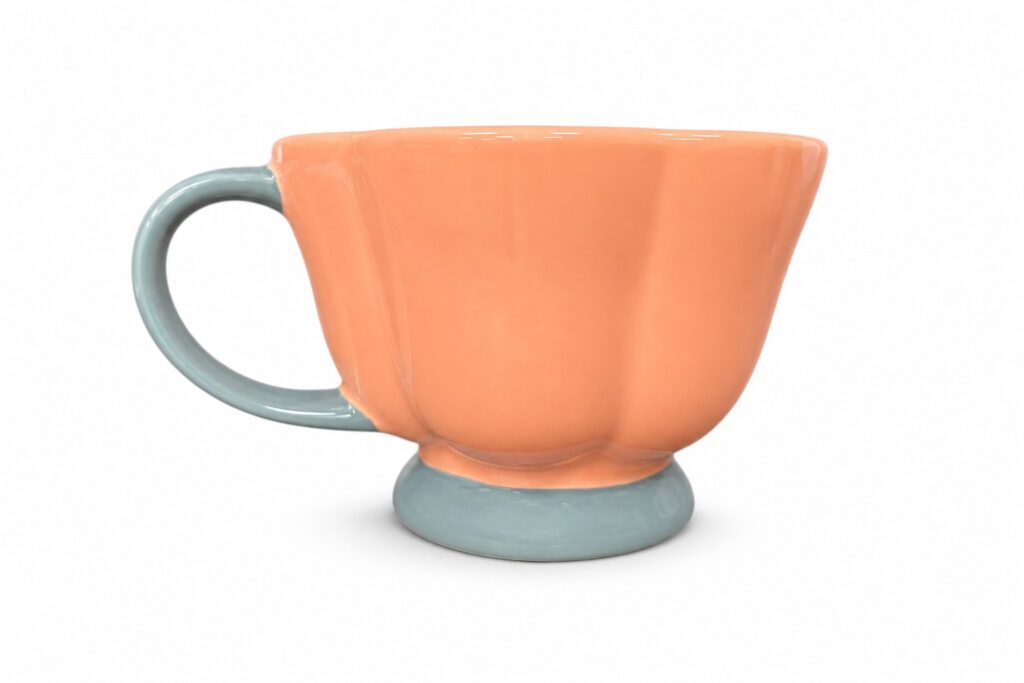
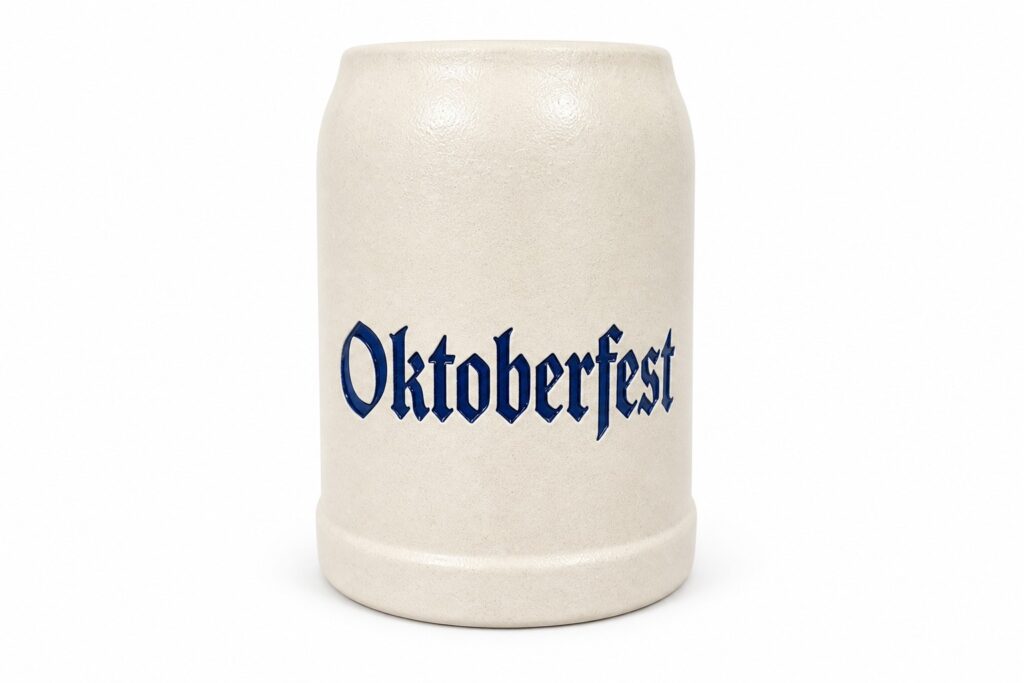
Intricate 3D relief and debossed geometry is where the compensated master earns its keep. An undercut-free relief — an animal’s snout in the round, or a debossed hop cone pressed into a stein wall — has to be drafted so the plaster releases cleanly, then scaled per region so the relief still reads at the same depth after 12–15% shrinkage. You can see the result on the 3D Peekaboo Frog Flower-Shaped Ceramic Mug, where the flower-shaped rim and the frog relief are cast as one piece rather than assembled, and on the Classic Oktoberfest Debossed Ceramic Beer Stein Mug, where the debossed hop-and-barley band holds a crisp edge at 500 ml production scale. Both belong to the same family of dimensional work we run for tiki and novelty barware, where deep relief is the entire product.
3. First-Firing Test Kilns & Thermal Tolerance
Prototypes are bisque-fired and then glaze-fired to 1310°C in a dedicated test kiln with a short, tightly controlled cycle, so that a glaze result is available in 24–36 hours rather than waiting for a full production car. The test kiln is profiled to match the production tunnel kiln’s time-temperature curve as closely as possible, which matters because glaze maturity, colour development and body vitrification are all functions of heat work, not peak temperature alone.
Each prototype is then checked against four thermal and mechanical criteria:
Thermal shock resistance. A fired sample is cycled between boiling water and ice water. A properly vitrified porcelain body at 1310°C should survive a differential of 130–140°C without crack initiation; anything that fails this check indicates either an under-fired body or a glaze whose coefficient of expansion is mismatched to the body.
Glaze fit. Crazing and shivering are both expansion-mismatch failures — one where the glaze is in tension, one where it is in compression. We read fit visually under magnification immediately after firing and again after 24 hours, since some mismatch only appears as the piece relaxes.
Dishwasher endurance. Samples go through an accelerated commercial cycle test to confirm no weight gain, no colour shift and no glaze breakdown. For a high-fire porcelain body below 0.2% water absorption, the expected result is no measurable change across 500 cycles.
Chip and impact resistance. Rim and handle are impact-tested, because a handle that survives firing but fails in a café is a warranty problem, not an aesthetic one.
Where a trial fails, the correction is made in the glaze or the firing profile and re-fired the next day — the digital geometry does not need to be reopened, which is why revisions inside the 7–10 day window are realistic rather than aspirational.
4. Streamlined Sampling for Global Retailers & Kickstarters
For a retailer or an e-commerce brand, the commercial risk in a new ceramic line is not the tooling cost — it is the calendar. A shape that slips by three weeks can miss a container booking, a seasonal window or a crowdfunding delivery promise.
Our sampling workflow is built around that risk:
Digital approval before physical tooling. The compensated 3D model, wall-thickness section and rendering are signed off remotely, so no plaster is poured against a shape the buyer has not seen. This removes the most expensive kind of revision.
One mould, multiple decorations. Because the working mould is banked after first approval, colourways, decals, reactive glazes and logo treatments can be trialled on the same geometry in parallel rather than serially. A five-colour range is five glaze trials, not five tooling cycles.
Photograph-ready first shots. Prototypes are supplied finished and glazed, so they can go straight to a photographer, a trade show or a crowdfunding campaign page without a second round of samples.
Tooling continuity into production. The master and working moulds from the prototyping cell transfer directly to the production line, so the approved prototype and the shipped production run share the same geometry and the same glaze recipe. No “sample-to-production drift.”
Typical deliverables at day 7–10: one to three glazed prototypes, a dimensional report against the target CAD, a glaze trial record with L*a*b* values, water-absorption test data, and a production quotation with MOQ and lead time.
Related Products
Geometry that survives the mould
Both pieces below started as a compensated 3D master and went from CAD to a glazed first shot inside the 7–10 day window described above — same master, same working mould, same glazes carried into production.
Start With a Model, Not a Mould
Rapid prototyping in ceramics is not about firing faster — kilns are already fast. It is about removing the serial dependencies between geometry, tooling and glaze, so that all three develop in parallel against a single compensated digital master. That is the whole method, and it is why a 7-day sample and a production-accurate master mould are not in conflict.
Have a shape in CAD, or just a sketch and a target capacity? Send the file or the drawing along with your intended glaze direction and annual volume, and our Dehua engineering team will return a shrinkage and tolerance plan plus a prototyping schedule within two business days. Contact Fugu Ceramics to begin your prototype.