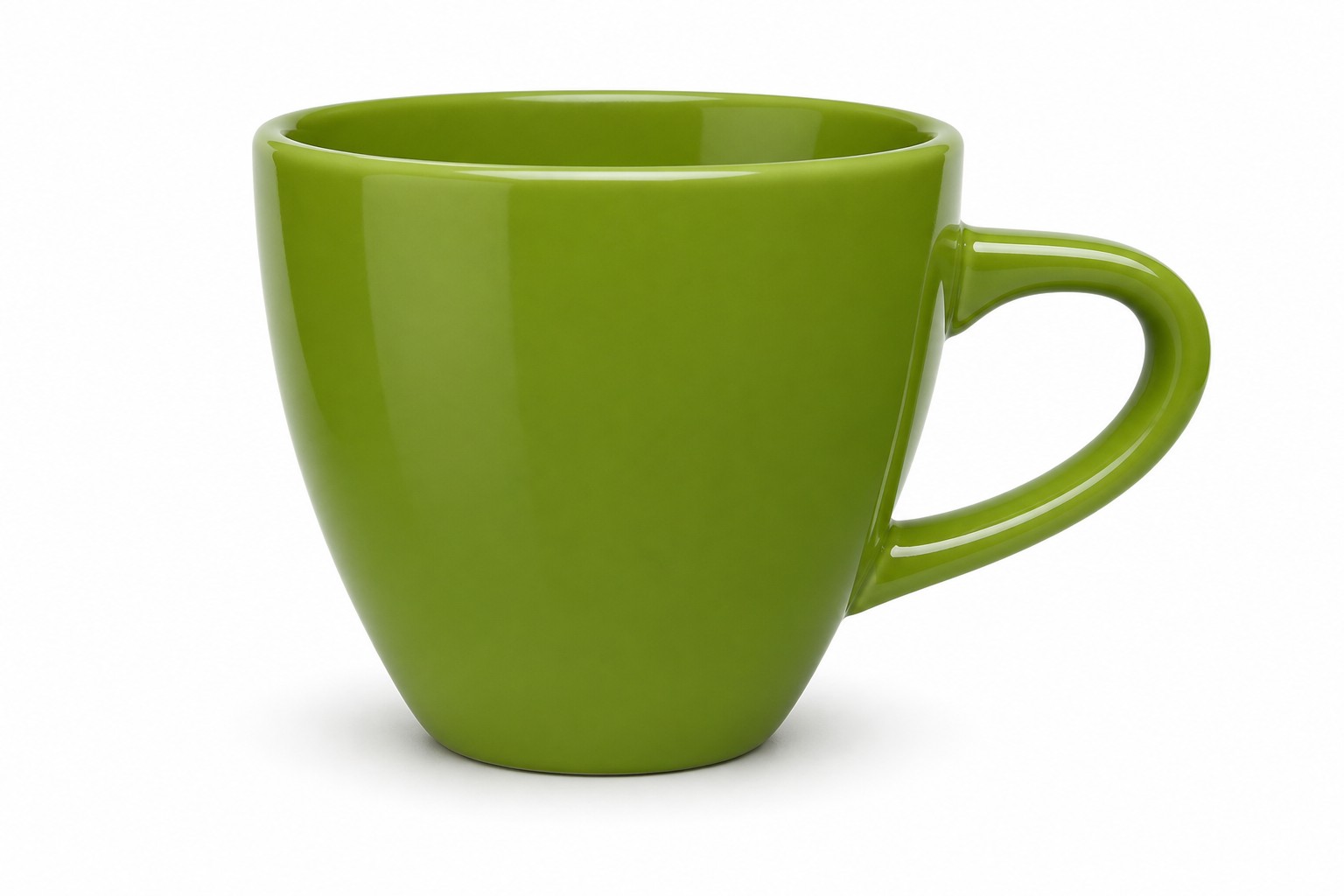
Every specialty coffee roaster eventually faces the same specification question: should the custom mug that carries the brand be high-fire porcelain fired to 1310°C, or mid-fire stoneware fired in the 1180–1220°C range? Both are vitrified ceramics. Both can be printed, glazed and branded. But they behave very differently after eighteen months of commercial dishwashing, daily thermal cycling and the kind of handling that only happens in a busy café.
This article breaks the decision down on the four criteria that actually matter to a coffee brand: vitrification science, water absorption and dishwasher durability, glaze chemistry for Pantone-accurate colour matching, and the raw material base — specifically why Dehua kaolin clay performs the way it does.
1. The Science of Vitrification at 1310°C
Vitrification is the process by which a ceramic body densifies as glassy phase forms between the clay particles. At 1310°C, the silica–alumina system in a porcelain body melts far enough to close open porosity almost completely, while the mullite needle network — the crystalline skeleton that gives porcelain its strength and translucency — continues to grow. The result is a body that is dense, dimensionally stable and optically warm: light passes through a 3–4 mm wall.
Mid-fire stoneware sits at a different point on the same curve. At 1180–1220°C the body sinters and becomes functionally vitrified, but a small volume of open porosity survives. Because stoneware bodies are formulated with more iron-bearing plastic clays and less pure kaolin, they fire to a warmer, more opaque colour and a slightly softer surface. That is a desirable aesthetic — it reads as handcrafted — but it is a different engineering outcome.
Practically, the 1310°C firing gives the moulding shop three advantages: a tighter fired-dimensional tolerance (typically ±0.5% on a 90 mm rim), a harder body that resists rim chipping during transport, and a fully sealed surface that does not require a post-firing sealant. For a brand shipping pallets to distributors, those three factors translate directly into lower breakage claims and fewer dimensional disputes.
2. Water Absorption & Commercial Dishwasher Durability (<0.2%)
Water absorption is the single most predictive number for long-term performance in a food-service environment. ISO 13006 classifies porcelain as having water absorption of 0.5% or less; a well-controlled 1310°C Dehua porcelain body routinely tests below 0.2%, and our production batches are sampled and recorded per kiln car.
Why does 0.2% matter more than 0.5%? Because absorption is not a static property. Each commercial dishwasher cycle — typically 60–90°C wash, a cold rinse, and a hot dry — drives a thermal shock of 40–60°C through the wall section, then re-saturates any open pore network. A body at 0.5% absorption gradually draws moisture into the interface between body and glaze. Over hundreds of cycles that moisture expands on heating, fatigues the glaze bond, and eventually produces the two failure modes cafés complain about most: crazing (a fine crackle in the glaze) and rim staining that cannot be washed out.
Below 0.2%, the pore network is effectively closed. Independent cycle testing on our high-fire porcelain mugs — 500 cycles in a commercial conveyor dishwasher at 70°C wash / 85°C rinse — shows no measurable weight gain, no glaze crazing and no loss of colour density. Mid-fire stoneware of good quality will usually survive the same test, but the margin is thinner, and the body remains more sensitive to detergent chemistry and to abrupt cooling.
There is also a thermal-shock dimension. A dense porcelain body tolerates a rapid temperature differential of roughly 130–140°C without stress cracking, which covers everything from a boiling Americano to an iced latte in the same vessel. Stoneware generally sits nearer 100–110°C, which is adequate in normal use but leaves less headroom for abuse.
That same margin is what lets us keep decorative detail on a working mug instead of flattening it for durability. The wall relief on tactile custom pieces like our 3D Peekaboo Hippo Ceramic Coffee Mug sits on a sub-0.2% absorption body, so the sculpted hippo survives the same commercial wash cycle as a plain café mug — and the glaze over it holds colour density because there is no porosity opening under the decoration. Every piece in our custom drinkware collection is specified on those two numbers first, aesthetics second.
3. Glaze Chemistry & Pantone Matching for Specialty Coffee Roasters
Brand colour is where the two bodies diverge most visibly. A glaze is a thin glass; its fired colour depends on the base glaze chemistry, the firing atmosphere and the colour of the body underneath. On a bright, low-iron porcelain at 1310°C, a small addition of cobalt, copper or a stain pigment reads cleanly and consistently — which is why packaging-grade colour matching is achievable.
At Fugu Ceramics we match to Pantone references using a two-step process. First, a spectrophotometer reading (D65, 8° observer) is taken from the client’s approved physical reference or Pantone chip and converted into a target L*a*b* value. Second, a ladder of glaze trials is fired on the actual production body, because the same glaze over a white porcelain and over an iron-bearing stoneware will land on different L* values — often 3–5 points apart, which is clearly visible side by side.
Because 1310°C porcelain is low in iron and fires to a neutral white, the delta between trials is small and repeatable, and we can hold a ΔE of under 1.5 between production lots. On mid-fire stoneware, the iron content and the reduction-sensitive clays introduce lot-to-lot variation that must be absorbed by the glaze, narrowing the achievable colour space and making exact brand matches harder to guarantee over repeat orders.
Reactive and speckled glaze effects, incidentally, are a legitimate reason to choose stoneware — the iron in the body blooms through a translucent glaze and produces the mottled look many third-wave roasters want. If the brand direction is a clean, saturated, precise colour, porcelain is the more controllable substrate.
4. Why Dehua Kaolin Clay Makes the Difference
Dehua, in Fujian Province, has been a porcelain centre since the Song dynasty, and the reason is geological. Local kaolin is exceptionally low in iron and titanium, with a high alumina content and a narrow particle-size distribution. Low iron means a whiter fired body and no grey cast under a clear glaze; high alumina means the body holds its shape through 1310°C without slumping; a tight particle distribution means the slip casts evenly and the fired shrinkage is predictable.
That last point is the one that shows up in production data. Dehua kaolin bodies in our mould shop hold a total shrinkage of 12–15% with a repeatability of about ±0.3%, which is what makes a master mould reusable for tens of thousands of pieces without dimensional drift. It also allows us to design walls to 3 mm in the rim and 4–5 mm at the base — thin enough to feel refined, thick enough to survive a commercial dishwasher and a busy pass.
The material also matters for food-contact compliance. Our high-fire porcelain is formulated without lead or cadmium in the glaze and is tested to FDA 21 CFR 175.300 and California Proposition 65 limits, with EU 1935/2004 and German LFGB migration testing available on request. Dense, low-absorption porcelain passes these tests with a wider margin than a more porous body, because there is no pore network to trap residue and release it later.
Featured Custom Ceramic Pieces
High-fire porcelain, seen in the hand
Every piece below is slip-cast, glazed and fired to 1310°C in our Dehua workshop — the same body and the same glaze lab described above.
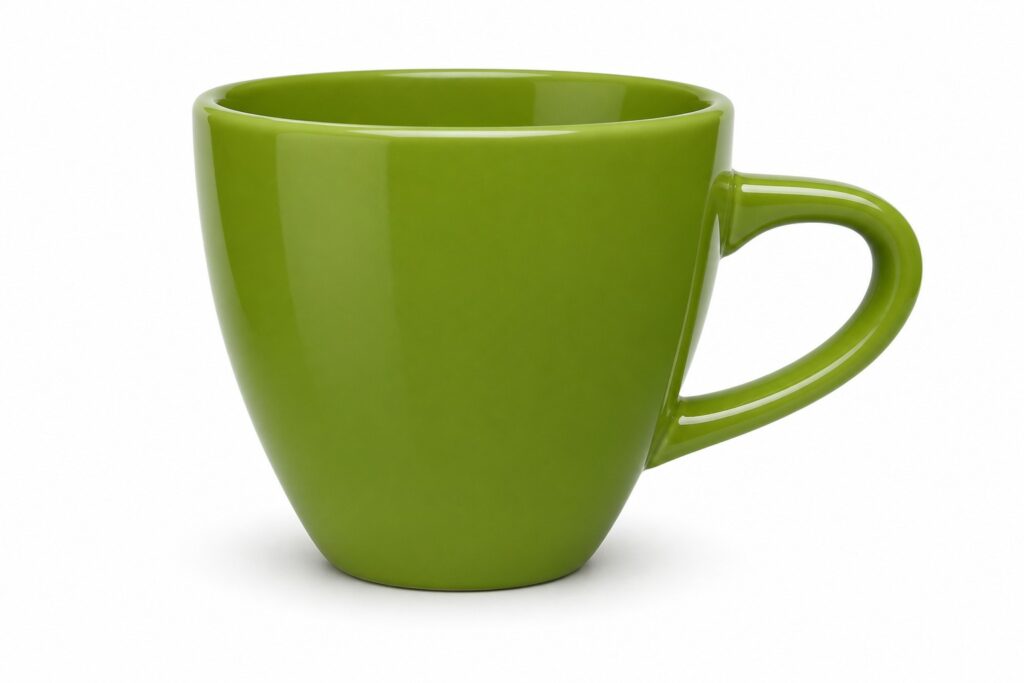
3D Peekaboo Hippo Ceramic Coffee Mug (330ml / 11oz)
330 ml / 11 oz, 1310°C high-fire porcelain, water absorption below 0.2%. A tactile 3D hippo relief sits on the wall of an otherwise clean, café-spec mug — under-glaze sculpture and Pantone-accurate colour on the same vitrified body.
Which Should You Specify?
If the priority is a precise brand colour, a refined thin wall, translucency, and the longest possible service life in a commercial dishwasher, specify 1310°C high-fire porcelain. If the priority is a rustic, iron-speckled, hand-thrown aesthetic and the mugs will live mainly in a retail or home environment, mid-fire stoneware is the honest choice.
Most specialty coffee brands that come to us end up with porcelain for the café and wholesale line, and stoneware for a limited seasonal release — which is usually the correct commercial answer, because the two bodies serve two different jobs.
Ready to specify your next custom mug programme? Send us your target capacity, wall thickness, Pantone reference and expected annual volume, and our Dehua engineering team will return a glaze trial plan, a shrinkage and tolerance sheet, and a quotation within two business days. Contact Fugu Ceramics to start your sample.