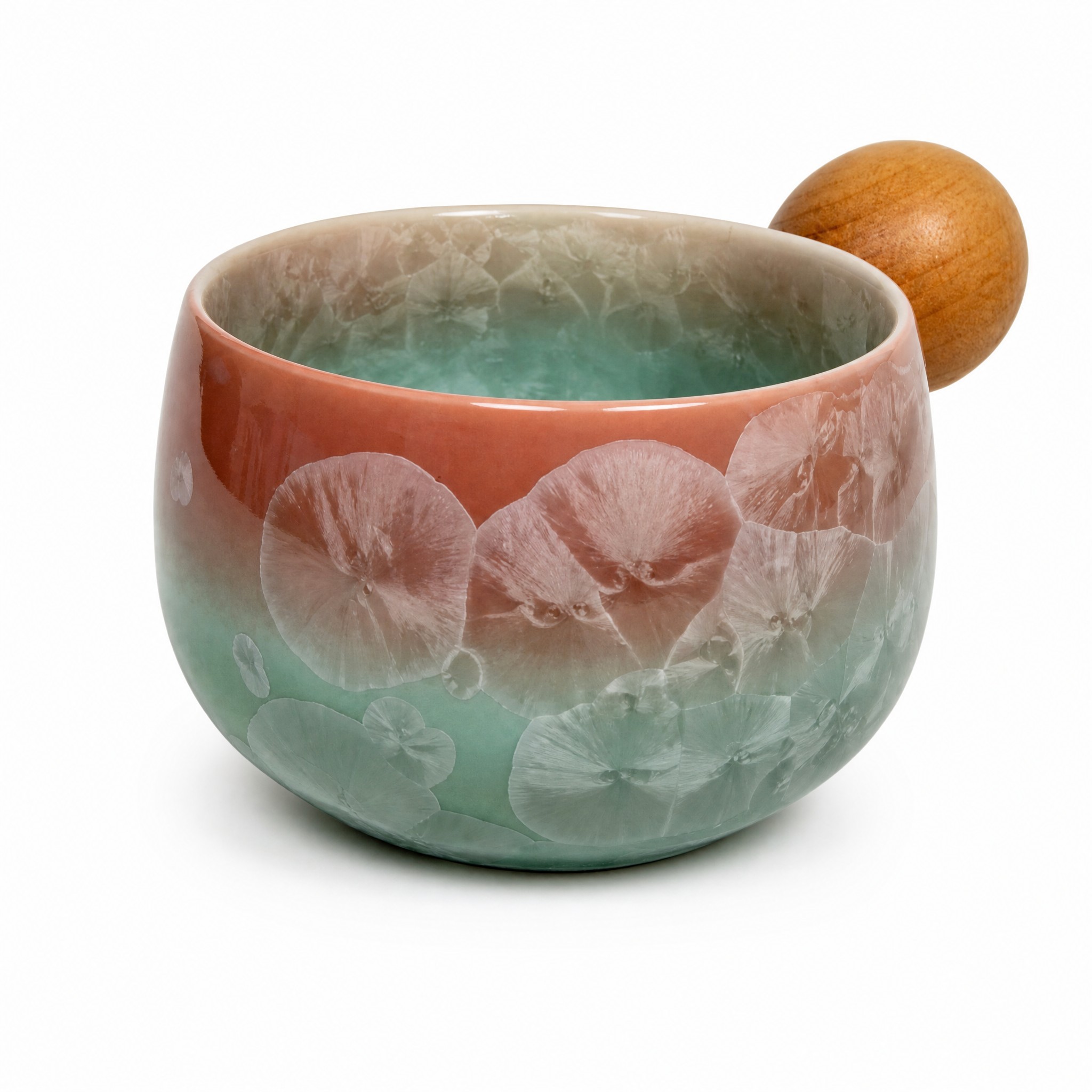
At first glance, crystalline glaze ceramics appear as though a master artisan spent hours delicately hand-painting ethereal, starburst-like frost patterns onto porcelain. In reality, not a single brushstroke ever touches the piece. Every petal, burst, and needle-like blossom is a geological marvel born inside the intense inferno of the kiln.
Crystalline glazes—specifically zinc silicate crystalline glazes—represent the absolute pinnacle of kiln transformation (yao bian, 窑变). Because mineral crystals precipitate spontaneously from molten liquid glass during controlled cooling, every single finished piece is an unrepeatable, one-of-a-kind art piece. Historically, this immense unpredictability made crystalline ceramics the domain of boutique studio potters. Today, advanced industrial engineering at Dehua Fugu Ceramics allows us to harness this organic beauty for consistent, brand-level B2B mass production.
Here is an insider’s look into the mineral chemistry, thermal dynamics, and factory quality controls required to master this breathtaking craft.
1. The Chemistry: What Actually Happens Inside the Glaze?
Unlike standard ceramic glazes that cool into a uniform, amorphous glass, a crystalline glaze is scientifically formulated to become supersaturated with specific crystal-forming oxides at high temperatures.
- The Crystal Engine (High Zinc + Low Alumina): In normal glazes, alumina (Al₂O₃) acts as a stiffener that prevents running and stops crystallization. In crystalline formulations, we intentionally drop alumina to minimal levels and introduce high concentrations of Zinc Oxide (ZnO) paired with Silica (SiO₂).
- The Precipitation Phase: As the kiln cools, zinc and silica chemically bond and precipitate out of the liquid glass matrix to form Willemite crystals (Zn₂SiO₄). These crystals nucleate at microscopic seed points and radiate outward in two-dimensional floral and fan-like formations.
- Color Chemistry: By introducing micro-dosed transition metal oxides into the base frit batch, we manipulate both the background glass and the floral crystals:
- Cobalt Oxide: Produces vibrant royal blue grounds with silver-blue crystal flares.
- Copper Carbonate / Oxide: Yields striking turquoise, emerald greens, or rich ruby hues.
- Iron & Nickel Oxides: Impart warm golden amber, honey-champagne, or earthy bronze tones.
- Factory Stability with Frits: For commercial production, we utilize pre-melted, standardized ceramic frits ground to 250–300 mesh (with a strict solid content of 62–65%) to ensure chemical uniformity across every batch.
2. Glaze Application: Precision Thickness & Run-Off Management
Because crystalline glazes have very low alumina content, they exhibit extreme fluid mobility at peak temperatures. If applied like normal glaze, it would run like water down the pot, fusing the vessel permanently to the kiln shelf.
| Process Stage | Engineering Standard at Fugu Ceramics |
|---|---|
| Greenware Preparation | Strictly bisqued (biscuit-fired) porcelain bodies. Greenware must be bone-dry prior to glazing; residual moisture creates violent glaze bubbling or shivering under rapid heat ramps. |
| Application Technique | Predominantly automated pressure-pot spray glazing (0.7 mm – 1.2 mm wet layer), allowing micron-level gradient control. Immersion dipping is reserved for specific rotational shapes. |
| Thickness Gradient | Tapered application: heavier at the rim and shoulder, progressively thinner toward the foot ring to compensate for thermal gravity run-down. |
| Kiln Catchers & Pedestals | Every vessel is fired atop a custom alumina-coated ceramic pedestal (catch basin) with a generous unglazed foot clearance, catching excess glass runoff without damaging the piece. |
| Natural Drying | Cured in humidity-controlled ambient drying rooms to eliminate internal thermal stresses before entering the kiln. |
3. The Firing Schedule: The 4 Critical Thermal Phases
Firing a crystalline glaze requires a computer-programmed thermal cycle where temperature and time dictate the exact size, quantity, and morphology of the crystal blossoms.
- Phase 1: Pre-Heating & Moisture Evacuation (Room Temp to 300°C)
A steady, gentle rise to evacuate lingering mechanical and atmospheric moisture, eliminating micro-cracking risks. - Phase 2: Rapid Fusion & Full Melting (300°C to 1260°C–1280°C)
A fast ramp to peak temperature. The glaze transforms into a completely liquid, homogeneous glass pool, melting all preliminary raw mineral seeds. Firing holds at top temperature for just 10–20 minutes to clear bubbles. - Phase 3: The Nucleation & Crystal Growth Window (1100°C to 1150°C Soak) — THE CRITICAL STAGE
The kiln is rapidly dropped to the crystal formation window (1100°C–1150°C) and held stationary for 1 to 3 hours. At this exact saturation plateau, crystal seeds take hold and bloom outwards.- Longer soak (2.5–3 hrs): Yields dramatic, large-scale macro-crystals and wide floral starbursts.
- Shorter soak (1–1.5 hrs): Creates dense, constellation-like micro-crystalline frost and starlight textures.
- Phase 4: Annealing & Controlled Cooling (1100°C down to 800°C → Ambient)
Gradual cooling through the silica transition zone in a pure oxidizing atmosphere, followed by ambient room cool-down to lock in brilliant surface luster.
4. Industry Pain Points vs. How Fugu Delivers B2B Stability
Many overseas buyers hesitate to source crystalline ceramics because boutique suppliers suffer massive reject rates (often 40%–60%). At Fugu Ceramics, our Dehua factory resolves these common defects through strict manufacturing discipline:
| Common Industry Defect | Root Cause | Fugu Ceramics Production Solution |
|---|---|---|
| No Crystal Formation | Insufficient ZnO, excess Al₂O₃, incorrect soak window, or premature cooling. | Single-source Dehua kaolin and feldspar with laboratory ICP chemical validation per batch. |
| Glaze Run-Off & Shelf Sticking | Glaze applied too thickly or peak temperature overshoot. | Automated multi-axis spray application + custom sacrificial pedestal footers. |
| Erratic Crystal Size & Clustering | Uneven thermal circulation across cold/hot zones in traditional kilns. | Multi-zone PLC microcomputer-controlled electric & gas kilns maintaining thermal variance within ±2°C across all racks. |
| Pinholes & Pitting | Glaze slurry micro-bubbles or incomplete greenware degassing. | 250–300 mesh high-shear slurry filtering with vacuum degassing and prolonged bone-dry baking. |
| Rough Surface Texture | Over-crystallization caused by excessive soak times. | Strictly timed computerized soak stages tailored to specific vessel wall thicknesses. |
5. Customization Options: Secondary Firing, Gold Luster & Branding
Can high-end crystalline glaze be customized with your brand identity? Absolutely.
Because crystalline glazes are fired at high porcelain temperatures (1260°C–1280°C), the vitrified body is exceptionally durable and non-porous. We frequently conduct secondary firings at 780°C–820°C to add:
- Metallic Overglaze Accents: Hand-painted genuine 12% real gold or platinum rims and luster handles.
- High-Fired Permanent Brand Logos: In-glaze or on-glaze ceramic decals that fuse indelibly into the glassy surface, ensuring dishwasher durability and premium gift presentation.
- Custom Color Matching: Tailored mineral frits to reflect your brand’s seasonal color palettes.
Explore how our craft philosophy bridges ancient kiln heritage with modern contract manufacturing in our founding manifesto: A Simple Place for Real Products, Real Craft, and Honest Conversations.
6. Elevate Your Product Line with Fugu Crystalline Ceramics
Whether you are developing an ultra-luxury line of Ceramic Candle Vessels & Jars, statement Specialty Coffee & Tea Drinkware, or bespoke hospitality tableware, crystalline glazes deliver an undeniable perceived value that commands premium retail price points.
Partner directly with our Dehua manufacturing studio to bring predictable, laboratory-grade crystalline porcelain into your next collection.